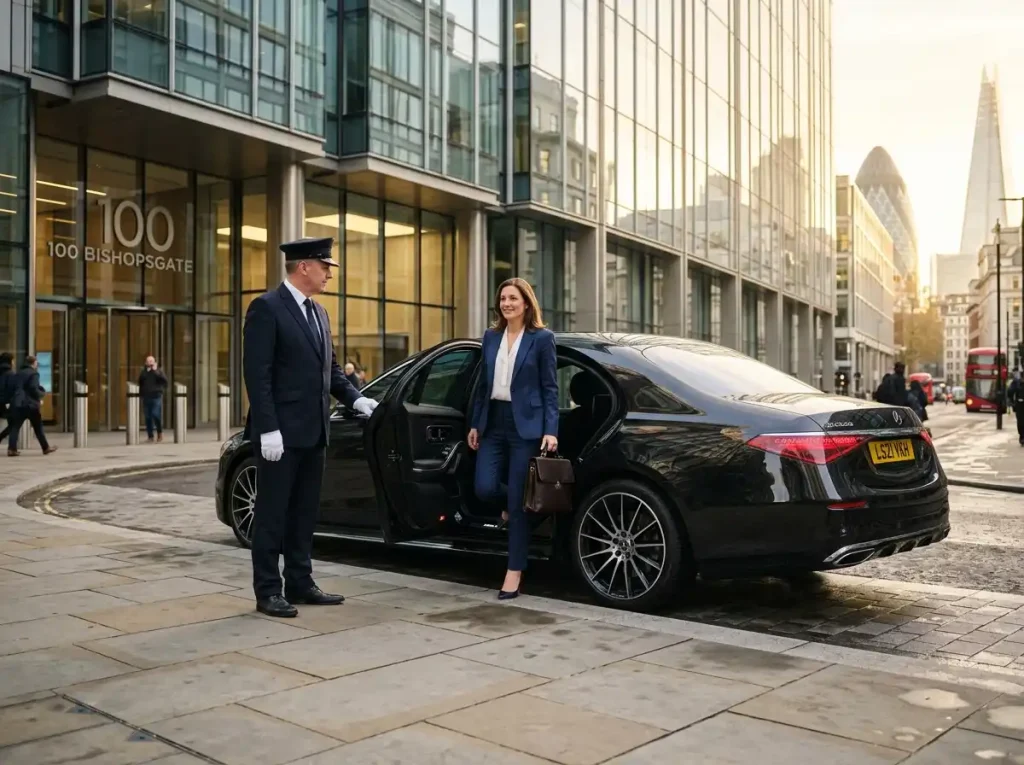
Most businesses start with one-off chauffeur bookings. A client pickup from Heathrow. A board meeting across town. A last-minute run to Birmingham. Each trip gets booked separately, paid for individually, and buried in someone’s expense report.
It works fine until it doesn’t. Three months in, nobody can tell you how much the company has spent on ground transport, receipts are scattered across six inboxes, and your finance team is chasing VAT invoices from three different providers.
That’s the point where a corporate chauffeur service starts making real financial sense. But how do you know when you’ve crossed that line? And what’s the actual cost difference between ad-hoc standard hire and a structured corporate account?
This guide breaks down the numbers, the hidden savings, and the practical differences so you can make the right call for your business.
What Exactly Is a Corporate Chauffeur Service?
A corporate chauffeur service is a structured, account-based arrangement between your business and a professional chauffeur company. Instead of booking each journey as a standalone transaction, your company gets a dedicated account with agreed pricing, consolidated invoicing, and priority availability.
Think of it as the difference between paying for individual gym sessions and taking out a membership. The service itself is the same quality of executive car hire UK you’d get with a one-off booking. The difference is in the billing, the consistency, and the operational benefits that come with it.
A standard hire, by contrast, is exactly what it sounds like. You need a car, you book a car, you pay for that single trip. No ongoing relationship, no account structure, no volume considerations.
Both get you a professional driver in a premium vehicle. The question is which model works better for how your business actually travels.
The Real Cost Comparison: Corporate Account vs One-Off Booking

Here’s where it gets interesting. The per-journey price difference between corporate and standard hire is often smaller than people expect. The real savings come from everywhere else.
| Cost Factor | Standard One-Off Hire | Corporate Chauffeur Account |
|---|---|---|
| Hourly rate (executive saloon) | £50 to £80 per hour | £45 to £75 per hour |
| Airport transfer (Heathrow) | £125 to £200 fixed | £100 to £170 fixed (agreed rate) |
| Full day hire (8 to 10 hours) | £400 to £800 | £350 to £700 (volume pricing) |
| Booking admin time | 15 to 20 mins per trip | 2 to 5 mins (saved preferences) |
| Invoice processing | Individual receipt per trip | One monthly invoice |
| VAT recovery | Often missed (no proper invoice) | Automatic (VAT invoice provided) |
| Cancellation terms | Varies by provider | Pre-agreed, consistent |
| Priority in peak periods | No guarantee | Priority allocation |
The per-trip savings of 10 to 15% matter, but they’re not the headline. The real story is in admin cost, VAT recovery, and time.
The VAT Angle Most Businesses Miss
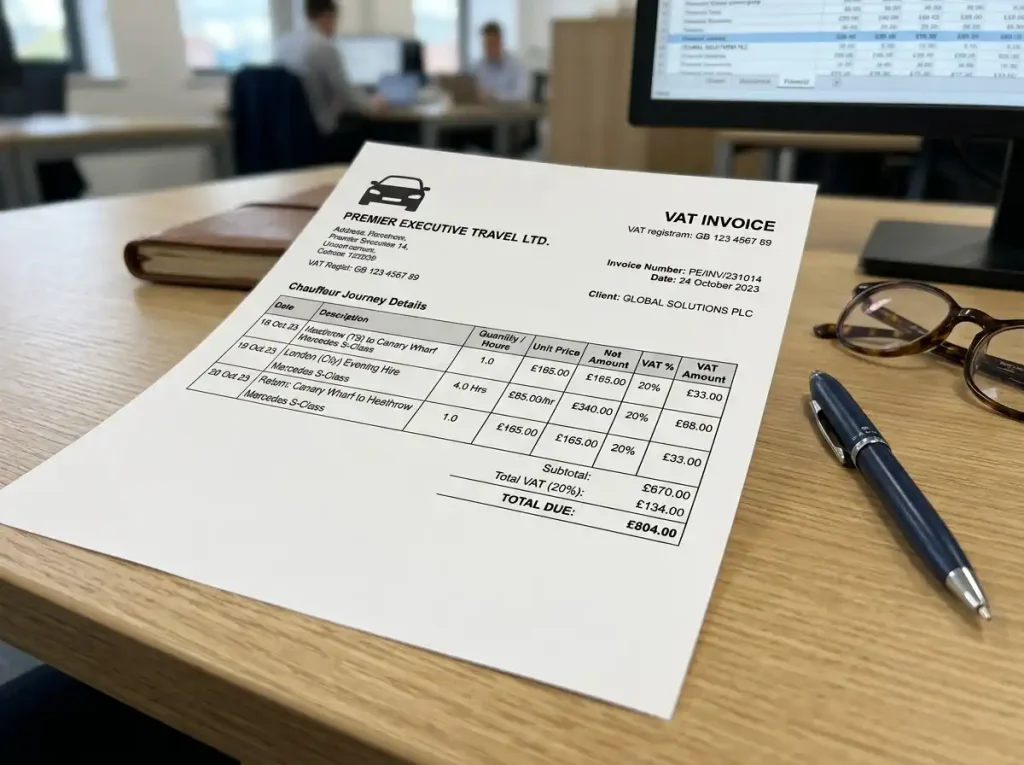
Here’s something that surprises a lot of finance teams. Unlike train tickets, which are zero-rated for VAT, chauffeur and private hire services charge 20% VAT when the operator is VAT-registered. And most professional chauffeur companies are.
That means every chauffeur booking your business makes is a VAT-reclaimable expense, provided you have a proper VAT invoice. On a corporate account, that invoice comes automatically at the end of each month with every journey itemised. You claim the full 20% back on your next VAT return.
On ad-hoc bookings? Most PAs and office managers get a payment confirmation email, not a proper VAT invoice. The VAT is still there in the price, but without the right paperwork, your accountant can’t reclaim it.
Do the maths on a company spending £1,500 per month on chauffeur travel. That’s £300 per month in reclaimable VAT, or £3,600 per year. On a corporate account, you get that back automatically. On scattered one-off bookings, you probably lose most of it.
According to HMRC guidance on business travel VAT, chauffeur and airport transfer firms that are VAT-registered will provide a VAT invoice on request, and they are generally set up for corporate account holders.
When Does a Corporate Account Make Financial Sense?
Not every business needs a corporate chauffeur account. If your company books a car twice a year for the Christmas party, one-off hire is perfectly fine.
But there’s a tipping point, and it comes sooner than most people think.
The 4-trip rule: If your business is booking four or more chauffeur journeys per month, regularly, a corporate account almost always pays for itself through rate reductions, VAT recovery, and admin savings alone.
Here’s a simple breakdown:
| Monthly Trips | Annual Spend (Standard) | Annual Spend (Corporate) | VAT Recovered | Net Annual Saving |
|---|---|---|---|---|
| 2 per month | £3,600 | £3,240 | £648 | ~£1,000 |
| 4 per month | £7,200 | £6,120 | £1,224 | ~£2,300 |
| 8 per month | £14,400 | £11,520 | £2,304 | ~£5,200 |
| 12+ per month | £21,600+ | £16,200+ | £3,240+ | ~£8,600+ |
Based on average UK executive saloon rates. Actual figures depend on routes, vehicle class, and provider.
These numbers don’t even include the time your PA or office manager saves by not having to compare providers, negotiate prices, and chase individual receipts every single trip.
Beyond Cost: What a Corporate Account Actually Changes Day to Day

Money matters, but the operational difference is just as significant. Here’s what changes when your business moves from ad-hoc booking to a proper corporate chauffeur service:
Consistency of service. Your drivers know your company’s standards. They know the regular routes, the preferred pickup points, which executives prefer a quiet cabin and which ones want to chat. That continuity builds over time, and it matters when you’re sending a car for a visiting CEO or an investor arriving from overseas.
Single point of contact. No more calling around three providers to see who’s available on short notice. One account manager, one number, one relationship.
Real-time flight tracking on airport transfers. Corporate accounts typically include automatic flight monitoring. If the 7am Heathrow arrival is delayed by 90 minutes, your driver adjusts without anyone needing to make a phone call.
Booking preferences saved. Water temperature, newspaper preference, child seats, preferred vehicle class. These details get logged once and applied to every future booking. It’s a small thing that makes a noticeable difference to client-facing pickups.
Management reporting. At the end of each month, you get a full breakdown: which departments booked what, total spend by journey type, busiest routes. For companies tracking travel budgets, this data is genuinely useful.
Which Vehicle Class Suits Corporate Travel?
Not every corporate journey needs a flagship saloon. Matching the right vehicle to the occasion keeps costs proportionate.
For daily executive travel, client meetings, and short-distance transfers, the Mercedes E-Class or Audi A6 delivers everything you need. Comfortable, quiet, professional. Hourly rates sit in the £45 to £75 range.
When the occasion calls for something more, the Mercedes S-Class is the benchmark. Long-wheelbase rear cabin, heated and cooling seats, near-silent ride. This is the right choice for senior executive pickups, investor meetings, and international client arrivals. Expect £70 to £120 per hour.
For group corporate travel, the Mercedes V-Class seats up to seven passengers with full luggage capacity. One vehicle instead of two saloons. Conference groups, team travel to off-site meetings, and multi-person airport runs all work better in the V-Class, often at lower total cost than splitting across multiple cars.
How to Set Up a Corporate Chauffeur Account
Setting up a corporate account is far simpler than most businesses expect. There’s no minimum contract length, no volume commitment, and no complicated onboarding process.
Here’s what it typically involves:
Contact the provider directly and discuss your regular travel patterns. This covers typical routes, frequency, preferred vehicle types, and how many people in your organisation will be booking.
Agree on pricing structure. Most providers offer fixed rates for regular routes (especially airport transfers from Birmingham, Heathrow, and Manchester) and discounted hourly rates for ad-hoc bookings.
Set up invoicing terms. Monthly consolidated invoicing with full VAT breakdown is standard. Some providers offer weekly billing for higher-volume accounts.
Add authorised bookers. Decide who in your company can book against the account, whether that’s a central PA, department heads, or individual travellers.
Start booking. That’s it. First journey can usually happen within 24 hours of account setup.
At ExecRide UK, corporate accounts come with priority availability across our full fleet covering 46 regions nationwide, a dedicated contact number, and no minimum booking requirement.
FAQ
How much does a corporate chauffeur service cost in the UK?
Corporate chauffeur service rates typically range from £45 to £120 per hour depending on vehicle class, with agreed fixed pricing for regular routes. Corporate accounts generally offer 10 to 15% lower rates than standard one-off bookings, plus VAT invoice provision for full 20% reclaim.
What is the difference between corporate chauffeur hire and standard chauffeur hire?
Standard hire is a single, standalone booking with per-trip payment. Corporate chauffeur hire operates through an account structure with consolidated monthly invoicing, pre-agreed rates, priority availability, saved preferences, and dedicated account management. The driver quality and vehicle standard are the same.
Can my business reclaim VAT on chauffeur services?
Yes. VAT-registered chauffeur operators charge 20% VAT on all bookings. With a corporate account, you receive a proper VAT invoice each month, allowing your business to reclaim the full 20% on your VAT return. On ad-hoc bookings without a formal invoice, this VAT is often lost.
How many trips per month justify a corporate chauffeur account?
Most businesses find a corporate account pays for itself at around four journeys per month. At that frequency, the combination of discounted rates, VAT recovery, and admin time savings typically exceeds £2,000 per year.
Do corporate chauffeur accounts require a minimum contract or commitment?
Most professional chauffeur providers, including ExecRide UK, do not require minimum contracts, long-term commitments, or volume guarantees. The account can be set up within a day, and you only pay for journeys you actually book.
Which UK airports are covered by corporate chauffeur transfers?
Corporate chauffeur accounts typically cover all major UK airports including Heathrow, Gatwick, Stansted, Luton, Birmingham, Manchester, Leeds Bradford, Edinburgh, Glasgow, and Bristol. Fixed pricing for regular airport routes is usually agreed as part of account setup.